Yin and Yang: The Foundation of Balance in TCM
Understand the concept of Yin and Yang in Traditional Chinese Medicine — how these opposing yet complementary forces govern health, and what happens when they fall out of balance.
Understanding Yin and Yang
The concept of Yin and Yang (阴阳) is the cornerstone of Chinese philosophy and Traditional Chinese Medicine. It describes how seemingly opposite forces are actually complementary, interconnected, and interdependent.
Nothing is purely Yin or purely Yang — everything contains both aspects. The familiar Taiji symbol (☯) illustrates this: within the dark Yin area is a dot of light Yang, and within the light Yang area is a dot of dark Yin.
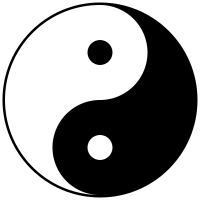
The Taiji (Yin–Yang) symbol is the usual graphic shorthand for complementary opposites in Chinese thought. (Site-hosted vector graphic.)
The Four Principles of Yin-Yang
1. Opposition
Yin and Yang represent opposite qualities:
| Yin (阴) | Yang (阳) |
|---|---|
| Cold | Hot |
| Dark | Bright |
| Rest | Activity |
| Interior | Exterior |
| Slow | Rapid |
| Moist | Dry |
| Descending | Ascending |
| Solid organs (Zang) | Hollow organs (Fu) |
| Blood | Qi |
2. Interdependence
Yin and Yang cannot exist without each other. Day has no meaning without night; activity has no meaning without rest. In the body, Qi (Yang) moves Blood (Yin), while Blood (Yin) nourishes and anchors Qi (Yang).
3. Mutual Consumption and Support
When Yin increases, Yang naturally decreases, and vice versa. Throughout the day, Yang peaks at midday and Yin peaks at midnight. Throughout life, Yang is abundant in youth while Yin declines with age.
4. Intertransformation
Under certain conditions, Yin can transform into Yang and vice versa. For example, extreme cold (Yin) can produce heat symptoms (Yang) — a concept known as “cold damage transforming into heat” in TCM pathology.
Yin and Yang in the Human Body
In TCM, health is defined as the dynamic balance of Yin and Yang. Each organ, tissue, and function can be categorized:
Yin aspects of the body:
- Body fluids, blood, essence (Jing)
- The solid organs: Heart, Liver, Spleen, Lung, Kidney
- Nourishment and moistening functions
- Structural, material aspects
Yang aspects of the body:
- Qi, warmth, metabolic activity
- The hollow organs: Small Intestine, Gallbladder, Stomach, Large Intestine, Bladder
- Warming and transforming functions
- Functional, energetic aspects
Common Yin-Yang Imbalances
Yin Deficiency (阴虚)
When the cooling, moistening, and resting aspects are insufficient:
- Heat sensations: Feeling hot, especially in the afternoon or evening
- Night sweats and “five-palm heat” (warmth in palms, soles, and chest)
- Dry mouth and throat, especially at night
- Insomnia, restless sleep, vivid dreams
- Thin, rapid pulse
- Red tongue with little coating
Yin deficiency often results from: chronic illness, overwork, insufficient sleep, excessive sexual activity, or prolonged emotional stress.
Yang Deficiency (阳虚)
When the warming, activating, and transforming aspects are insufficient:
- Cold sensations: Feeling cold, especially in the limbs and lower back
- Pale complexion
- Fatigue, lethargy, lack of motivation
- Frequent, clear urination
- Edema, especially in the lower body
- Slow, weak pulse
- Pale, swollen tongue with teeth marks
Yang deficiency often results from: aging, chronic illness, excessive cold exposure, overconsumption of cold foods, or congenital weakness.
Yin Excess
Less common than deficiency. Characterized by:
- Feeling cold and heavy
- Water retention and edema
- Excessive mucus and discharges
- Dull, aching pain
Yang Excess
Often manifests as:
- High fever, inflammation
- Red face, red eyes
- Agitation, irritability
- Strong, forceful pulse
Restoring Yin-Yang Balance
For Yin Deficiency
- Prioritize rest and adequate sleep
- Eat Yin-nourishing foods: pear, apple, watermelon, cucumber, tofu, honey, sesame
- Avoid spicy, heating foods and stimulants
- Practice gentle exercises like Tai Chi rather than intense workouts
- Manage stress and emotional volatility
For Yang Deficiency
- Keep warm, especially the lower back and feet
- Eat warming foods: ginger, cinnamon, lamb, beef, walnuts, dried longan
- Avoid cold, raw foods and excessive air conditioning
- Gentle exercise to stimulate Yang without exhausting it
- Get morning sunlight exposure
Yin-Yang in Daily Life
Understanding Yin-Yang can improve daily wellness:
- Sleep: Night is Yin time — going to bed before 11 PM supports Yin nourishment
- Exercise: Morning (Yang rising) is ideal for physical activity; evening (Yin growing) is better for gentle stretching
- Seasons: Summer (Yang) calls for cooling foods; winter (Yin) calls for warming nourishment
- Work: Balance productive hours (Yang) with rest and recovery (Yin)
Key Takeaways
- Yin and Yang are complementary opposites that exist in dynamic balance
- Health is the harmonious interplay of Yin and Yang within the body
- Most health issues stem from either Yin deficiency, Yang deficiency, or imbalance between them
- Diet, lifestyle, and seasonal awareness can help maintain Yin-Yang harmony
Disclaimer: This article is for educational purposes only. Consult a licensed TCM practitioner for personalized diagnosis and treatment.
Related Articles
FAQ
Who is this article for?
This article is for readers who want a practical, beginner-friendly understanding of this TCM topic.
Can this article replace professional medical advice?
No. This content is educational only and should not replace diagnosis or treatment from a qualified healthcare professional.
Disclaimer
This content is for educational purposes only and does not constitute medical advice. Always consult a qualified healthcare professional for diagnosis and treatment.