The Five Elements Theory: Understanding Wood, Fire, Earth, Metal, and Water in TCM
Explore the Five Elements (Wu Xing) theory in Traditional Chinese Medicine — how Wood, Fire, Earth, Metal, and Water interact through generating and controlling cycles to explain health, disease, and the natural world.
What is the Five Elements Theory?
The Five Elements theory, known as Wu Xing (五行) in Chinese, is one of the foundational philosophical frameworks of Traditional Chinese Medicine. It categorizes all natural phenomena into five fundamental phases — Wood, Fire, Earth, Metal, and Water — and describes how they interact through cycles of generation and control.
Unlike the Greek concept of four static elements, Wu Xing emphasizes dynamic processes and relationships. The word “Xing” (行) means “to walk” or “to move,” suggesting that these elements are not substances but phases of transformation.
Educational charts often map the five phases to organs, seasons, and emotions so that patterns are easier to remember in clinic and self-care.
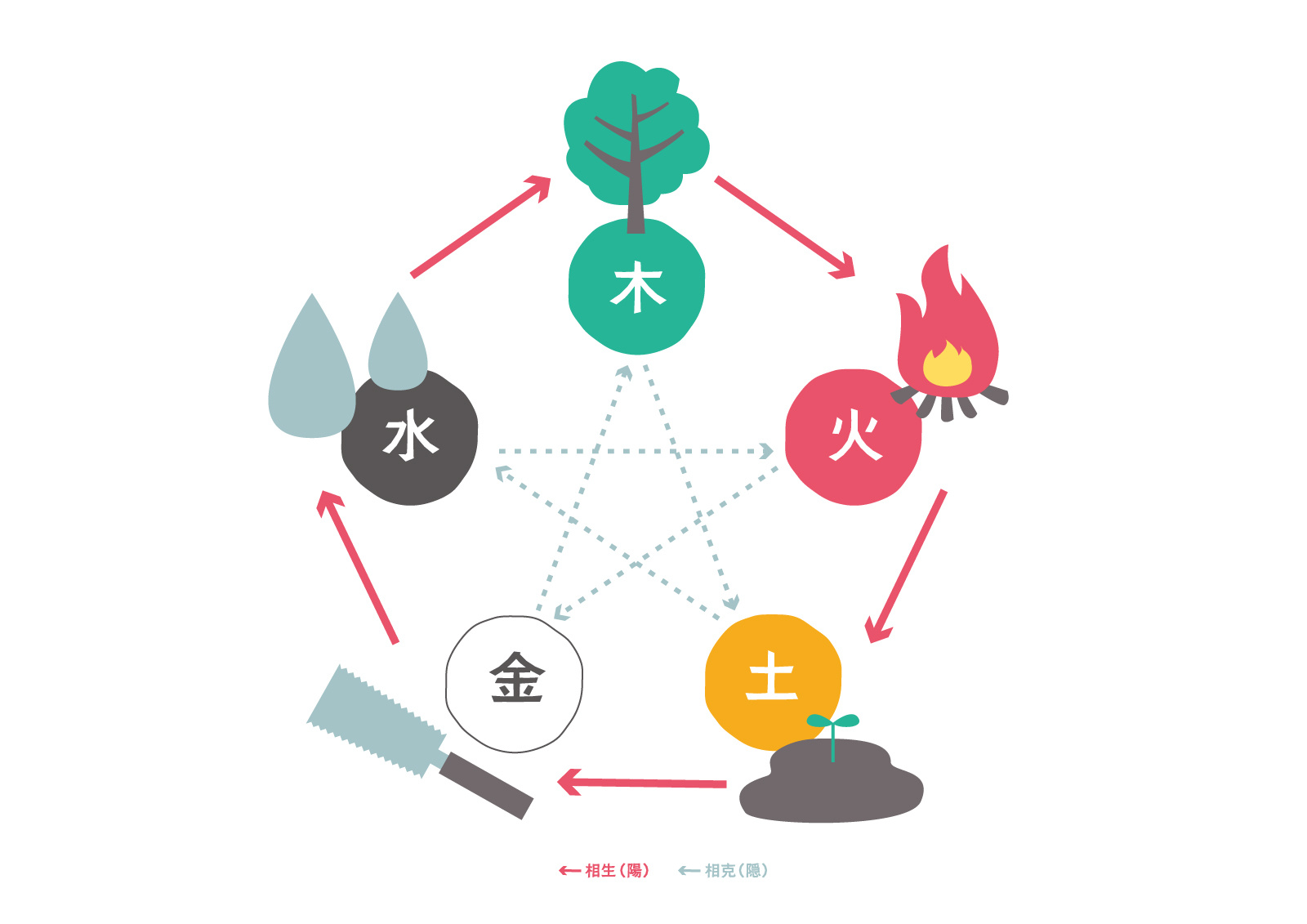
Simplified generating cycle (Xiang Sheng) layout for orientation — clinical charts add organ, season, and emotion tables around the same idea. (Site-hosted schematic.)
The Five Elements and Their Correspondences
Each element is associated with specific organs, seasons, emotions, tastes, colors, and climates:
| Correspondence | Wood | Fire | Earth | Metal | Water |
|---|---|---|---|---|---|
| Zang Organ | Liver | Heart | Spleen | Lung | Kidney |
| Fu Organ | Gallbladder | Small Intestine | Stomach | Large Intestine | Bladder |
| Season | Spring | Summer | Late Summer | Autumn | Winter |
| Emotion | Anger | Joy | Worry | Grief | Fear |
| Taste | Sour | Bitter | Sweet | Pungent | Salty |
| Color | Green | Red | Yellow | White | Black |
| Climate | Wind | Heat | Dampness | Dryness | Cold |
| Tissue | Tendons | Blood vessels | Muscles | Skin/hair | Bones |
| Sense Organ | Eyes | Tongue | Mouth | Nose | Ears |
Wood (木)
Wood represents the energy of growth, expansion, and upward movement — like a tree pushing through the soil in spring. It governs the Liver and Gallbladder, and is associated with planning and decision-making.
When Wood energy is balanced, a person is decisive, creative, and adaptable. When imbalanced, anger and frustration may arise, along with digestive issues, menstrual problems, or migraines.
Fire (火)
Fire embodies heat, transformation, and radiant energy. It governs the Heart and Small Intestine, and is associated with joy and communication.
Balanced Fire brings warmth, enthusiasm, and clarity of thought. Excess Fire may cause insomnia, anxiety, or inflammation; deficient Fire may lead to coldness and lack of vitality.
Earth (土)
Earth represents nourishment, stability, and transformation — the soil that sustains all life. It governs the Spleen and Stomach, the core of digestion and nutrient distribution.
Balanced Earth provides groundedness, empathy, and strong digestion. Imbalanced Earth leads to worry, overthinking, fatigue, and digestive weakness.
Metal (金)
Metal symbolizes structure, clarity, and letting go — like autumn leaves falling from trees. It governs the Lungs and Large Intestine, organs of taking in and releasing.
Balanced Metal brings discipline, organization, and the ability to grieve and let go. Imbalanced Metal may manifest as grief, rigidity, respiratory issues, or constipation.
Water (水)
Water embodies stillness, storage, and potential — the deep reserves of winter. It governs the Kidneys and Bladder, the root of vitality and reproduction.
Balanced Water brings wisdom, courage, and endurance. Imbalanced Water may lead to fear, willpower deficiency, lower back pain, or urinary issues.
The Generating Cycle (相生)
The cycle below is often drawn as a star or ring in textbooks: follow the generating arrows to see how each phase supports the next (Wood feeds Fire, Fire returns nutrients to Earth, and so on).
The Generating Cycle (Xiang Sheng) describes how each element nourishes and creates the next:
- Wood generates Fire — Wood feeds Fire as fuel
- Fire generates Earth — Fire produces ash that enriches Earth
- Earth generates Metal — Earth contains and forms Metal
- Metal generates Water — Metal condenses Water from the air
- Water generates Wood — Water nourishes the growth of Wood
This cycle explains the mother-child relationship in TCM. For example, the Liver (Wood) is the “mother” of the Heart (Fire). If Heart Fire is deficient, one treatment strategy is to tonify the mother — strengthen Liver Wood.
The Controlling Cycle (相克)
The Controlling Cycle (Xiang Ke) describes how each element restrains and regulates another:
- Wood controls Earth — Roots of trees hold soil in place
- Fire controls Metal — Fire melts Metal
- Earth controls Water — Dams and banks contain Water
- Metal controls Wood — Axes cut Wood
- Water controls Fire — Water extinguishes Fire
This cycle ensures that no element becomes excessive, maintaining dynamic equilibrium.
Pathological Cycles
When the normal generating and controlling relationships break down, disease occurs:
Overacting (相乘)
When one element excessively controls another beyond normal regulation. For example, excessive Liver Wood overacts on Spleen Earth, causing digestive problems — a common pattern known as “Liver invading Spleen” (肝乘脾).
Insulting (相侮)
When the controlled element reverses and attacks its controller. For example, if Spleen Earth becomes too strong, it may “insult” Liver Wood, reversing the normal controlling direction.
Clinical Applications
Diagnosis by Five Elements
Practitioners use Five Elements correspondences to identify patterns:
- A patient with greenish complexion, anger, and rib-side pain → Wood element disorder (Liver)
- A patient with red face, insomnia, and bitter taste → Fire element disorder (Heart)
- A patient with pale lips, worry, and poor appetite → Earth element disorder (Spleen)
Treatment Strategies
Five Elements theory guides several treatment approaches:
- Tonify the Mother (补母): When a child element is deficient, strengthen its mother. Example: tonify Kidney Water to strengthen Liver Wood.
- Drain the Child (泻子): When a mother element is excessive, drain its child. Example: drain Heart Fire to reduce Liver Wood excess.
- Control the Overacting: Suppress the element that is over-controlling another.
Five Elements in Daily Life
Understanding your dominant element can guide wellness choices:
- Wood types should manage stress, exercise regularly, and eat green vegetables
- Fire types should moderate stimulation, practice calming activities, and avoid excessive heat
- Earth types should maintain regular meals, avoid overthinking, and strengthen digestion
- Metal types should practice deep breathing, maintain boundaries, and process grief
- Water types should keep warm, conserve energy, and nourish Kidney essence
Key Takeaways
- The Five Elements (Wood, Fire, Earth, Metal, Water) categorize natural phenomena and body functions
- The Generating Cycle (相生) shows how elements nourish each other
- The Controlling Cycle (相克) shows how elements regulate each other
- Pathological patterns (overacting and insulting) explain disease mechanisms
- Five Elements theory guides diagnosis and treatment in TCM clinical practice
Disclaimer: This article is for educational purposes only. Consult a licensed TCM practitioner for personalized diagnosis and treatment.
Related Articles
FAQ
Who is this article for?
This article is for readers who want a practical, beginner-friendly understanding of this TCM topic.
Can this article replace professional medical advice?
No. This content is educational only and should not replace diagnosis or treatment from a qualified healthcare professional.
Disclaimer
This content is for educational purposes only and does not constitute medical advice. Always consult a qualified healthcare professional for diagnosis and treatment.