Meridians and Channels: The Energy Highways of the Body in TCM
Understand the meridian system in Traditional Chinese Medicine — the 12 primary channels, how Qi flows through them, and why they are central to acupuncture and TCM therapy.
What Are Meridians?
In Traditional Chinese Medicine, meridians — called Jing Luo (经络) in Chinese — are the pathways through which Qi (vital energy) and Blood circulate throughout the body. Think of them as an invisible network of energy highways connecting the organs, limbs, and all parts of the body.
The meridian system includes:
- 12 Primary Meridians — paired channels connected to specific organs
- 8 Extraordinary Vessels — deeper reservoir channels
- Countless branches and collaterals — finer pathways reaching every cell
Historical wall charts and modern textbooks still rely on full-body line drawings so that students can memorize point locations relative to bones, joints, and skin landmarks.
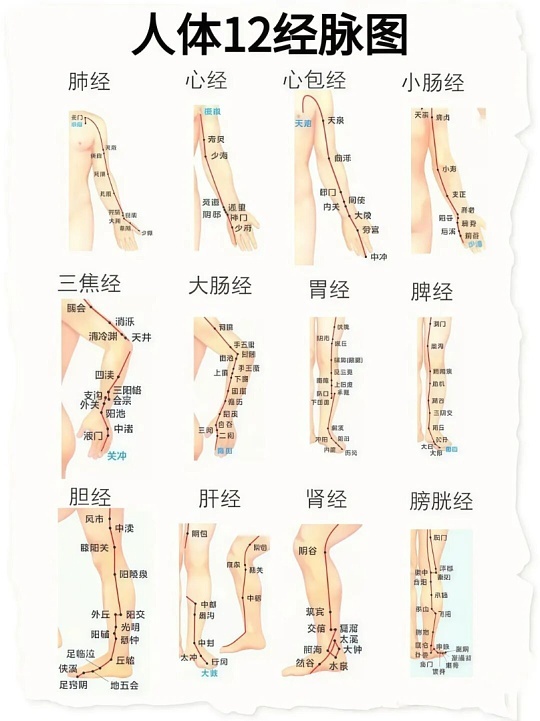
The 12 Primary Meridians
The 12 Primary Meridians
The 12 primary meridians are divided into Yin and Yang pairs, each connected to a specific Zang (solid) or Fu (hollow) organ:
Yin Meridians (Flow from Chest to Toes/Fingers)
| Meridian | Chinese | Paired Organ | Element |
|---|---|---|---|
| Lung | 手太阴肺经 | Lung (Zang) | Metal |
| Spleen | 足太阴脾经 | Spleen (Zang) | Earth |
| Heart | 手少阴心经 | Heart (Zang) | Fire |
| Kidney | 足少阴肾经 | Kidney (Zang) | Water |
| Pericardium | 手厥阴心包经 | Pericardium | Fire |
| Liver | 足厥阴肝经 | Liver (Zang) | Wood |
Yang Meridians (Flow from Head/Fingers to Feet/Head)
| Meridian | Chinese | Paired Organ | Element |
|---|---|---|---|
| Large Intestine | 手阳明大肠经 | Large Intestine (Fu) | Metal |
| Stomach | 足阳明胃经 | Stomach (Fu) | Earth |
| Small Intestine | 手太阳小肠经 | Small Intestine (Fu) | Fire |
| Bladder | 足太阳膀胱经 | Bladder (Fu) | Water |
| Triple Burner | 手少阳三焦经 | San Jiao (Fu) | Fire |
| Gallbladder | 足少阳胆经 | Gallbladder (Fu) | Wood |
How Qi Flows Through the Meridians
Qi flows through the 12 meridians in a specific 24-hour cycle:
Lung (3-5 AM) → Large Intestine (5-7 AM) → Stomach (7-9 AM)
→ Spleen (9-11 AM) → Heart (11 AM-1 PM) → Small Intestine (1-3 PM)
→ Bladder (3-5 PM) → Kidney (5-7 PM) → Pericardium (7-9 PM)
→ Triple Burner (9-11 PM) → Gallbladder (11 PM-1 AM) → Liver (1-3 AM)
→ Lung (cycle repeats)
This is the basis of the TCM Body Clock — symptoms that appear at specific times often point to imbalances in the corresponding organ system.
Acupuncture Points on the Meridians
In practice, a point is not only a dot on a chart: palpation, tenderness, and changes in skin texture often guide where a clinician applies needles or pressure along the same meridian route.
Along each meridian are specific acupuncture points (穴位) where Qi can be accessed and regulated. There are:
- 361 standard acupuncture points on the 14 main channels (12 primary + 2 extraordinary)
- Extra points outside the main channels
- Ashi points (“ouch points”) — tender spots that appear with disharmony
Each point has specific functions. For example:
- LI4 (Hegu): On the Large Intestine meridian — relieves headaches, promotes labor
- ST36 (Zusanli): On the Stomach meridian — tonifies Qi, strengthens digestion
- LV3 (Taichong): On the Liver meridian — moves Liver Qi, relieves stress
The 8 Extraordinary Vessels
These are deeper reservoir channels that store and regulate Qi and Blood:
- Du Mai (Governing Vessel) — Runs along the spine; governs all Yang meridians
- Ren Mai (Conception Vessel) — Runs along the front midline; governs all Yin meridians
- Chong Mai (Penetrating Vessel) — The “sea of blood”; regulates menstruation
- Dai Mai (Girdle Vessel) — Wraps around the waist; binds all meridians
- Yang Qiao Mai — Regulates Yang, affects locomotion and eyes
- Yin Qiao Mai — Regulates Yin, affects sleep and eyes
- Yang Wei Mai — Maintains Yang meridians; connects exterior
- Yin Wei Mai — Maintains Yin meridians; connects interior
Why Meridians Matter
Understanding meridians is central to many TCM therapies:
- Acupuncture: Inserts needles at specific points to regulate Qi flow
- Acupressure: Uses finger pressure instead of needles
- Moxibustion: Applies heat to points along meridians
- Cupping: Creates suction along meridian pathways
- Tui Na: Massage following meridian routes
- Qigong: Exercises designed to clear and strengthen meridian flow
Meridian Disharmony Symptoms
When a meridian is blocked or imbalanced, symptoms appear along its pathway:
- Lung meridian: Cough, chest tightness, arm pain along the channel
- Stomach meridian: Toothache, facial pain, knee pain, stomach issues
- Liver meridian: Rib pain, headaches, groin pain, eye problems
- Bladder meridian: Back pain, headache at the occiput, urinary issues
Related Articles
FAQ
Who is this article for?
This article is for readers who want a practical, beginner-friendly understanding of this TCM topic.
Can this article replace professional medical advice?
No. This content is educational only and should not replace diagnosis or treatment from a qualified healthcare professional.
Disclaimer
This content is for educational purposes only and does not constitute medical advice. Always consult a qualified healthcare professional for diagnosis and treatment.